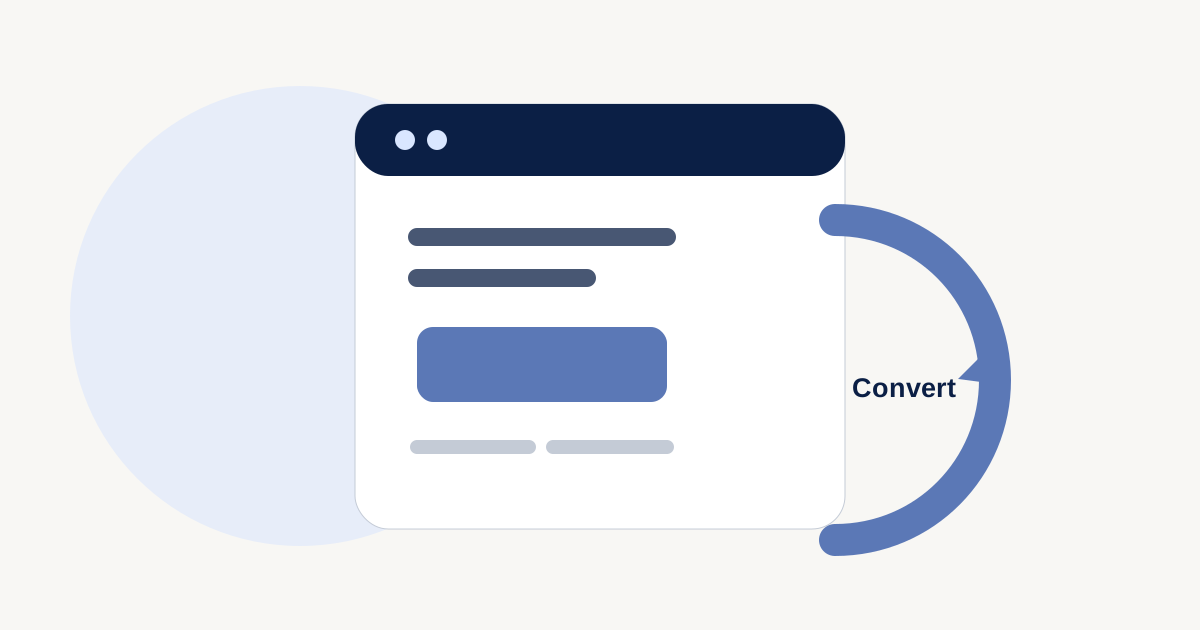
When a customer clicks an ad that speaks directly to their pain and lands on a generic product page that starts a completely different conversation, the conversion work the ad just completed is undone — and this is one of the most consistent value leaks we have seen across performance marketing accounts. Advize is an AI-powered performance marketing agency that treats the ad and landing page as a single continuous conversation rather than two separate assets, because the moment the customer has to re-convince themselves to be interested is the moment the funnel breaks. Here is what this looks like in practice and why it matters more than most teams realise.
Why does a generic landing page hurt conversion after a specific ad?
A specific ad creates a specific expectation. The customer clicked because one particular message resonated — a pain it named, a desire it activated, an argument it started. When that customer arrives at a generic product page, they must mentally search for the specific thing that caused them to click. The page is not in conversation with them. It is broadcasting general information. The question the customer arrives with — 'does this solve my specific problem?' — is not immediately answered. That moment of cognitive friction is where conversion is lost.
What does message continuity look like in practice?
Message continuity means the first thing a visitor reads on the landing page is a direct extension of the specific claim the ad made. Not a headline about the brand. Not a general product description. The same argument, continued.
Ad about time wasted on manual payroll → Landing page opens with: 'The average business owner spends X hours per month on payroll they could eliminate today.'
Ad about family choosing different room aesthetics → Landing page opens with: 'Every room in your home can reflect a different personality. Here is how.'
Ad about painting anxiety and trusting workers → Landing page opens with: 'Worried about letting strangers repaint your home? Here is what we guarantee.'
In each case, the visitor does not have to search for the conversation they were already in. The page continues it immediately.
How did we discover this problem on our accounts?
On one B2B lead-generation account, we initially prioritised creative testing because that was the clearest bottleneck. We deliberately avoided changing creative and landing pages simultaneously — because doing so makes it impossible to attribute the cause of any result change. Once we had established creative learnings and identified which messaging territories were working, the next observation was that performance could still vary significantly depending on where the click landed. The same creative message arriving at a dedicated aligned page consistently converted better than arriving at a general product page. The ad had done the work. The page was undoing it.
How do you build a landing page that continues the ad's argument?
Three questions drive the process.
First: What is the single specific claim or problem the ad addresses? Identify the one thing — not the product overview, not the feature list — that caused the click.
Second: What does the visitor need to believe in the next thirty seconds to stay on the page? The above-fold section should immediately confirm that this page is about that specific thing.
Third: What is the simplest path from the ad's claim to the conversion event? Remove any content between the opening and the CTA that is not directly supporting the specific argument the ad began.
The landing page should feel, from the visitor's perspective, like they never left the ad. The context they had when they clicked should still be active when they decide whether to convert.
Does this mean every ad needs a different landing page?
Ideally, yes — for the ads that have demonstrated enough signal to justify the investment. In practice, this does not mean building a completely different page for every creative. It often means changing the above-fold headline, the opening paragraph, and potentially one or two visual elements to match the specific messaging territory of the ad. The underlying product information and conversion mechanics can remain the same. The opening conversation changes. That is often sufficient to significantly improve the message continuity experience. We moved toward dedicated landing-page experiences for major creative propositions after initial creative learning was established on accounts where this was possible. The principle is not 'build infinite pages.' It is 'do not force every specific ad to land on a maximally generic page.'
Conclusion
Message continuity between ad and landing page is not a copywriting nicety. It is a conversion lever. The ad establishes a specific promise, problem, or argument. The landing page should immediately confirm that the visitor has landed in the right place by picking up exactly where the ad left off. We tested creative before testing landing pages on one account because changing both simultaneously makes it impossible to know what caused the result. But once the creative learning was established, the landing-page alignment experiments consistently produced meaningful conversion improvements. The two assets should be designed as one conversation.