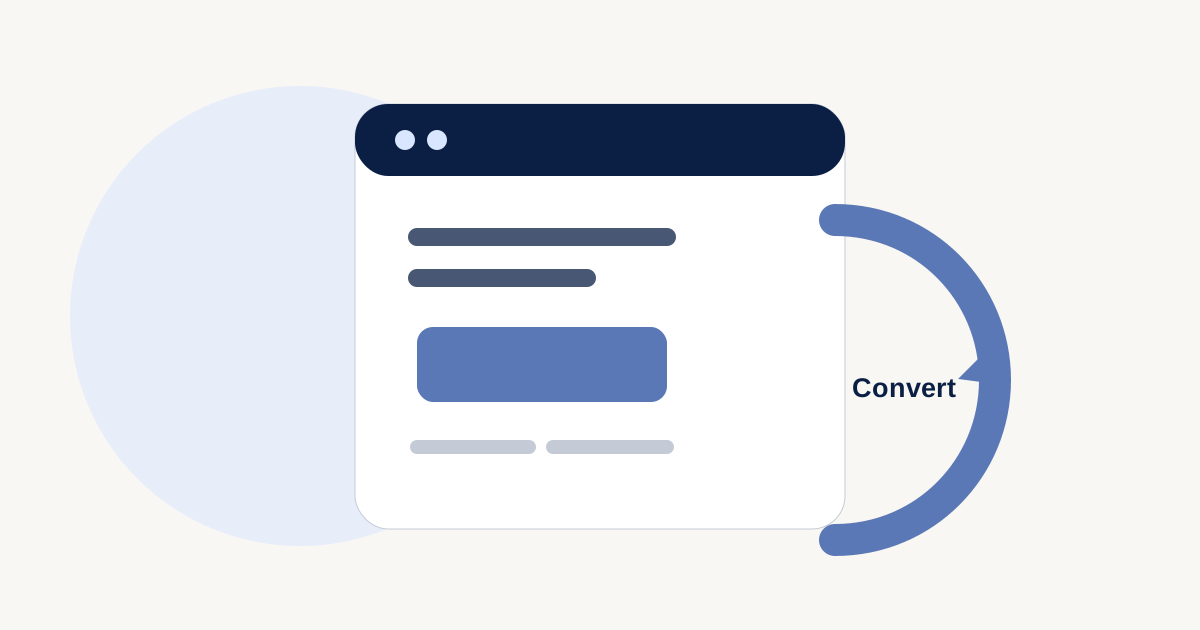
The landing page's first sentence should feel like the next sentence of the ad — picking up exactly where the ad's last line left off, continuing the thought, carrying the specific momentum the ad produced in the viewer's attention. Most landing pages open with a fresh thought instead: a brand positioning statement, a generic headline, a different framing of the same product. The fresh thought breaks the momentum. The visitor was in motion toward a specific understanding; the page restarts the motion from zero. The specific transition that converts ad momentum into page engagement is treating the ad and the page as one continuous piece of writing with the click as a comma, not a period.
Landing page's first sentence picks up where the ad's last left off. Click is a comma, not a period. Preserves 10-15 percent of conversion that most pages lose by restarting from brand-positioning. Single-sentence rewrite is one of the highest-return CRO interventions available.
Why does the ad-to-page click act as a continuation rather than a reset?
The ad-to-page click acts as a continuation because the viewer's attention is already in motion. The ad built specific attention — a specific product in mind, a specific promise, a specific tone. That attention is in the visitor's head when they land on the page. The question for the page is whether to continue the thought or restart it. Continuing preserves the momentum. Restarting discards it. Most pages restart, which is why most landing pages lose some of the attention the ad produced before they have a chance to convert it. The right design frame is to treat the ad and the page as one continuous piece of writing — the ad is the opening, the click is the comma, the page is the continuation. The visitor should not have to re-engage from zero.
What specifically breaks when the page opens with brand positioning instead?
What breaks when the page opens with brand positioning is the specific thought the ad put in the visitor's head. The ad said 'reduce acne in 6 weeks.' The page says 'Welcome to BrandName — advanced skincare for every skin type.' The visitor had 'reduce acne in 6 weeks' in mind, scrolled past the ad with that specific intent, clicked, and landed on an identity statement for a brand they had not yet decided to care about. The intent they clicked with has to be reconstructed before it can convert. The reconstruction is where the loss happens — some visitors do the work, more do not, and the page converts at a lower rate than it would have if the opening had carried the ad thought forward.
What does a first sentence that continues the ad actually look like?
If the ad's last line was 'reduce acne in six weeks,' the page's first sentence could be: 'Here is exactly how six weeks reduces acne.' Or: 'The six-week protocol works because of three specific mechanisms.' Or: 'You can start today — the results compound by week two.' All three carry the specific thought forward. None reintroduces the brand or shifts the frame. The visitor's existing attention is used, not restarted. If the ad's last line was 'the mascara your influencer friend already knows,' the page's first sentence could be: 'Here is why it is the one she is already recommending.' Or: 'The specific formula she means — and what makes it different.' The pattern is: pick up the thread, carry it one step further, give the visitor the next piece of the thought.
How does this change based on whether the ad is video or static?
The principle is the same across video and static but the specific transition point differs. For a video ad, the 'last sentence' is the final frame — the specific closing claim, the final text overlay, or the voice-over's last line. The page's first sentence picks up from that specific closing. For a static ad, the 'last sentence' is the dominant text in the ad — the hook, the headline, the CTA copy. The page's first sentence continues from that dominant text. The common thread is that the page's first sentence should feel like it was written as the next line of the specific ad asset the visitor just saw, not as a generic opening that works for any traffic source.
What are the three common ways landing pages break this principle?
1) Opening with brand positioning — 'BrandName is a performance marketing agency that helps brands grow' as the first sentence restarts the visitor from zero regardless of what the ad said. 2) Opening with a generic benefit statement — 'Finally, skincare that works for every skin type' is adjacent to a specific ad hook but not continuous with it. 3) Opening with the product name as a title — 'The Clarity Serum' as a headline reintroduces the product the ad already named, which wastes the first sentence on identification rather than continuation. All three are standard page design and all three leak attention the ad built. The scent trail works when the page smells like the ad, and the first sentence is where the smell either lands or breaks.
How do you rewrite the first sentence for your top 10 landing pages?
1) List the 10 landing pages receiving the most ad traffic in the account. 2) For each page, identify the primary ad(s) driving clicks to it and extract the specific hook or closing claim. 3) For each page, draft a new first sentence that picks up from the ad's closing. 4) The new first sentence should be short (10-20 words), should not include the brand name or product name as an identification, and should continue the specific thought the ad left in the visitor's head. 5) Deploy as A/B test versus the existing opening for 14 days. 6) Measure conversion rate for ad-sourced traffic specifically. 7) The lift usually shows within the first week because the fix operates on every pageview, and the compounding effect across top-traffic pages makes this a high-leverage single hour of work.
Conclusion
The ad-to-page transition is one piece of writing broken by a click, and treating it that way produces specific conversion lift because it preserves the attention momentum the ad produced. Most landing pages treat the click as a reset and restart from a brand-positioning position, which loses the momentum entirely. The practical next step for any team currently opening landing pages with brand slogans or generic positioning is to rewrite the first sentence of the top 10 highest-spend landing pages as a direct continuation of the ad they receive clicks from. In Advize's experience, the single-sentence rewrite typically produces 10-15 percent conversion lift within 30 days, which is one of the highest return-per-hour-of-work interventions available in paid acquisition.